REFinBlog

Editor: David Reiss
Cornell Law School

April 21, 2015

Tuesday’s Regulatory & Legislative Round-Up

By Serenna McCloud

  • Enterprise Community Partners made comments to the Senate Finance Committee’s Community Development and Infrastructure Tax Reform Working Group, as part of a New Market Tax Credit Coalition, which is calling for preservation of the credit as it has been critical to the development of affordable housing.
  • Federal Housing Finance Agency finds, after studying the matter, “no compelling economic reason” to change the guarantee fees charged by Fannie May and Freddie Mac. FHFA’s review focused on reaching an appropriate balance between FHFA’s statutory obligations to: 1) ensure the safety and soundness of the Enterprises, and 2) foster a liquid national housing finance market.

April 21, 2015 | Permalink | No Comments

April 20, 2015

Reiss on Low Interest Rates & Down Payments

By David Reiss

MainStreet quoted me in How to Get the Lowest Mortgage Rates Without a Large Down Payment. It reads in part,

Low mortgage rates can play a large factor whether homeowners are able to save tens of thousands of dollars in interest.

Even a 1% difference in the mortgage rate can save a homeowner $40,000 over 30 years for a mortgage valued at $200,000. Having a top-notch credit score plays a critical factor in determining what interest rate lenders will offer consumers, but other issues such as the amount of your down payment also impact it.

*     *     *

Opt For an FHA or ARM

Both an adjustable rate mortgage (ARM) and a Federal Housing Administration (FHA) mortgage are good options if homeowners are concerned about receiving a lower interest rate and have not been able to accumulate the 20% standard down payment.

The biggest benefit of an ARM is that they have lower interest rates than the more common 30-year fixed rate mortgage. Many ARMs are called a 5/1 or 7/1, which means that they are fixed at the introductory interest rate for five or seven years and then readjust every year after that, said David Reiss, a law professor at Brooklyn Law School in N.Y. The new rate is based on an index, perhaps LIBOR, as well as a margin on top of that index.

While many homeowners gravitate toward a 30-year mortgage, younger owners “should seriously consider getting an ARM if they think that they might move sooner rather than later,” he said.

FHA loans can be a good option for consumers purchasing their first home because they require much smaller down payment of 3.5%.

*     *     *

Given that young households tend not to have the savings for a substantial down payment, they can be an attractive option, Reiss said.

April 20, 2015 | Permalink | No Comments

Monday’s Adjudication Roundup

By Shea Cunningham

April 20, 2015 | Permalink | No Comments

April 17, 2015

Reiss on Low Credit Scores and Mortgages

By David Reiss

MainStreet quoted me in A Low Credit Score Does Not Prevent You From Purchasing a Home. It reads in part,

While consumers who have low credit scores have fewer options to choose from, many can still qualify for a mortgage.

Lenders determine the mortgage rate based on a potential homeowner’s credit score, amount of down payment and how much debt he has compared to his current income.

What Your Credit Score Means

Credit scores play a large factor in the interest rate a borrower will receive because lenders are determining the likelihood of someone defaulting on a loan or missing payments, said Jason van den Brand, CEO of Lenda, a San Francisco-based online home mortgage service.

“It’s important to remember that the costs of a loan are closely associated to how ‘risky’ it is to give the loan,” he said. “If you look like a riskier borrower, your loan will cost more.”

Low mortgage rates can play a substantial factor in a homeowner’s ability to save tens of thousands of dollars in interest. Even a 1% difference in the mortgage rate can save a homeowner $40,000 over 30 years for a mortgage valued at $200,000.

*     *     *

Both an adjustable rate mortgage (ARM) or a Federal Housing Administration (FHA) mortgage are good options if homeowners are concerned about receiving a lower interest rate and have not been able to accumulate the standard 20% down payment.

The biggest benefit of ARMs is that they offer lower interest rates than the more common 30-year fixed rate mortgage and are good options for first-time homebuyers. Many ARMs are called a 5/1 or 7/1, which means that they are fixed at the introductory interest rate for five or seven years and then readjust every year after that, said David Reiss, a law professor at Brooklyn Law School.

FHA loans can be a good option, because they require a much smaller down payment of 3.5%.

*     *     *

Given that young households tend not to have the savings for a substantial down payment, FHA loans can be particularly attractive, Reiss said.

April 17, 2015 | Permalink | No Comments

Friday’s Government Reports

By Serenna McCloud

There is a dearth of reports to report today, I have decided to post a beautiful poem in honor of Spring and Earth Day by Emily Dickinson:

A Light Exists In Spring

A Light exists in Spring
Not present on the Year
At any other period —
When March is scarcely here

A Color stands abroad
On Solitary Fields
That Science cannot overtake
But Human Nature feels.

It waits upon the Lawn,
It shows the furthest Tree
Upon the furthest Slope you know
It almost speaks to you.

Then as Horizons step
Or Noons report away
Without the Formula of sound
It passes and we stay —

A quality of loss
Affecting our Content
As Trade had suddenly encroached
Upon a Sacrament.

April 17, 2015 | Permalink | No Comments

April 16, 2015

Reiss on Homes as Investments

By David Reiss

US News and World Report quoted me in Is Your Home a Sound Investment? It reads in part,

Whether it’s beautiful new construction or a rehabbed fixer-upper, the place we call home demands time, attention and upkeep over the years. All this can enhance its value, and to be sure, Rich Arzaga inhabits a fabulous residence in San Ramon, California. The founder and CEO of Cornerstone Wealth Management estimates that its value approaches $1.9 million. The 5,400 square-foot abode boasts a swimming pool and a built-in barbecue, and has undergone more than a half-million dollars in improvements since he purchased it in 2005.

He considers the money well-spent: But does his home a double as a sound financial investment? As much as Arzaga loves his lodgings, he’d also argue that homeownership doesn’t translate into a smart addition to his portfolio – or anyone else’s, for that matter.

“We have seen many scenarios where a family would be much better off today, and in the future, renting,” Arzaga says. “Most people who insist that owning is a great investment are purely emotional on the matter and have not done any serious overall calculation. They are blinded by a feeling.”

Arzaga says he’s got the statistical analyses to back up his assertions. Yet expert opinion varies greatly as to whether a home represents a great investment. No single answer reflects a one-size-fits-all scenario any more than a cute brick bungalow resembles a sprawling suburban mansion.

*     *     *

Still, others pit themselves on both sides of the debate over the value of homeownership from an investment angle. “My view is that a home is not an investment, but it can certainly be a profitable noninvestment,” says David Reiss, a professor of law and research director at the Center for Urban Business Entrepreneurship at Brooklyn Law School.

Reiss maintains that the notion of “value” should revolve around financially intangible factors, although certainly, those could increase a home’s value over time. “Are there good schools and playgrounds for your kids? Is it near your job and your social network? If the answer is no, that’s a good reason to pass on a house that seems like a good deal,” he says.

April 16, 2015 | Permalink | No Comments

Thursday’s Advocacy & Think Tank Round-Up

By Serenna McCloud

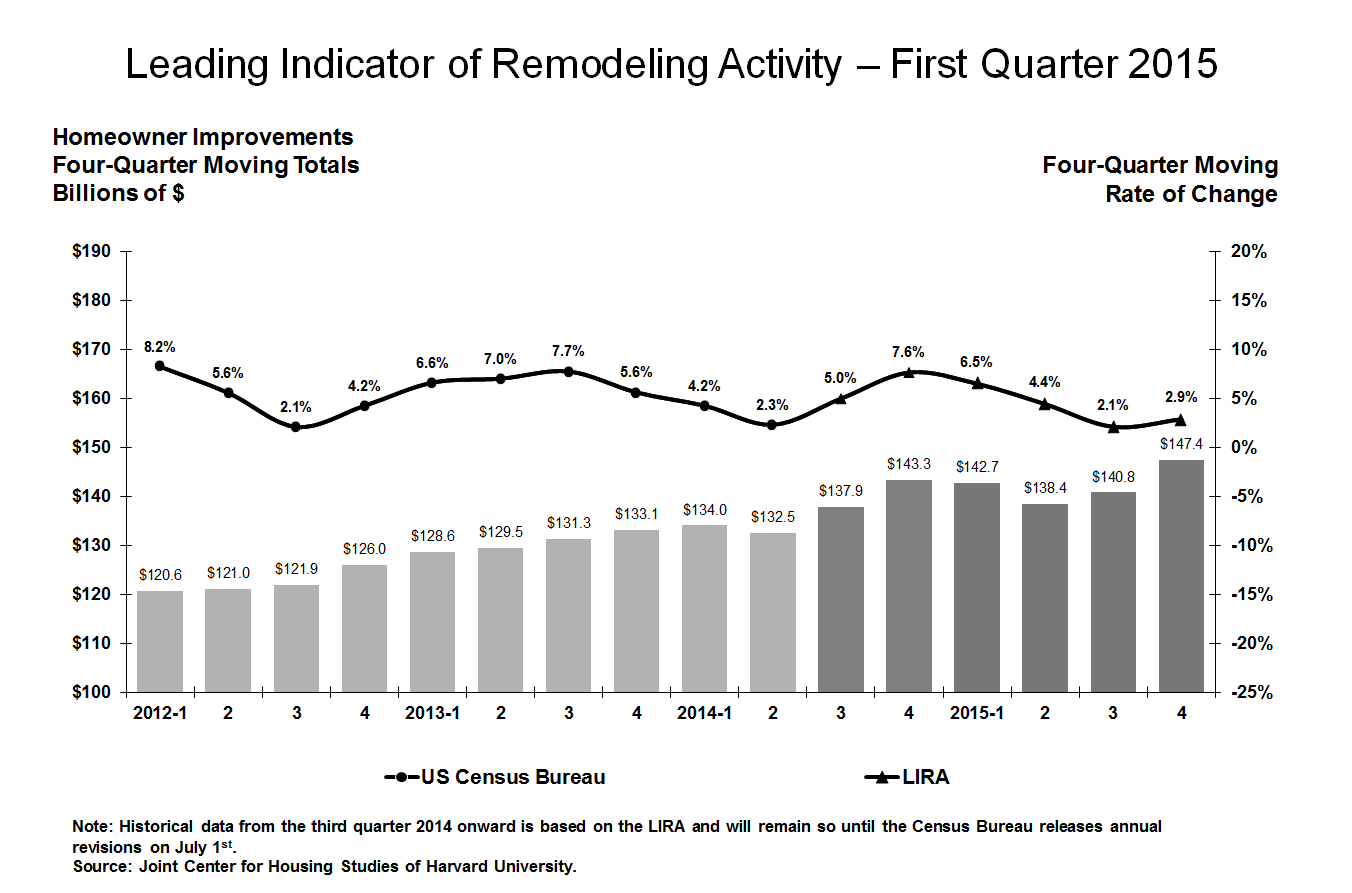
  • Harvard’s Joint Center for Houses Studies released its Leading Indicator of Remodeling Activity (LIRA) which predicts a deceleration in remodeling activity due to sluggish home sales, the LIRA also projects annual spending for home improvements will increase a more modest 2.9% in 2015.
  • National Association of Realtors’ testimony before the United States Senate Committee on Banking, Housing and Urban Affairs, Hearing titled Regulatory Burdens to Obtaining Mortgage Credit, argues that unnecessary burdens prevent qualified buyers from obtaining mortgages in today’s market.

April 16, 2015 | Permalink | No Comments